In this guide
- Collect the master policy and governing documents first
- Understand the North Carolina framework without oversimplifying it
- Insure the interior property for which you are responsible
- Protect belongings and temporary living expenses
- Read loss-assessment coverage and deductible limitations
- Check personal liability and water-damage concerns
- Coordinate coastal wind and flood at both levels
- Disclose seasonal stays and rental activity
- Prepare a complete submission when coverage is difficult
- Use a coordinated condo coverage checklist
- Keep association and individual renewals connected
- Frequently asked questions
- Sources and further reading
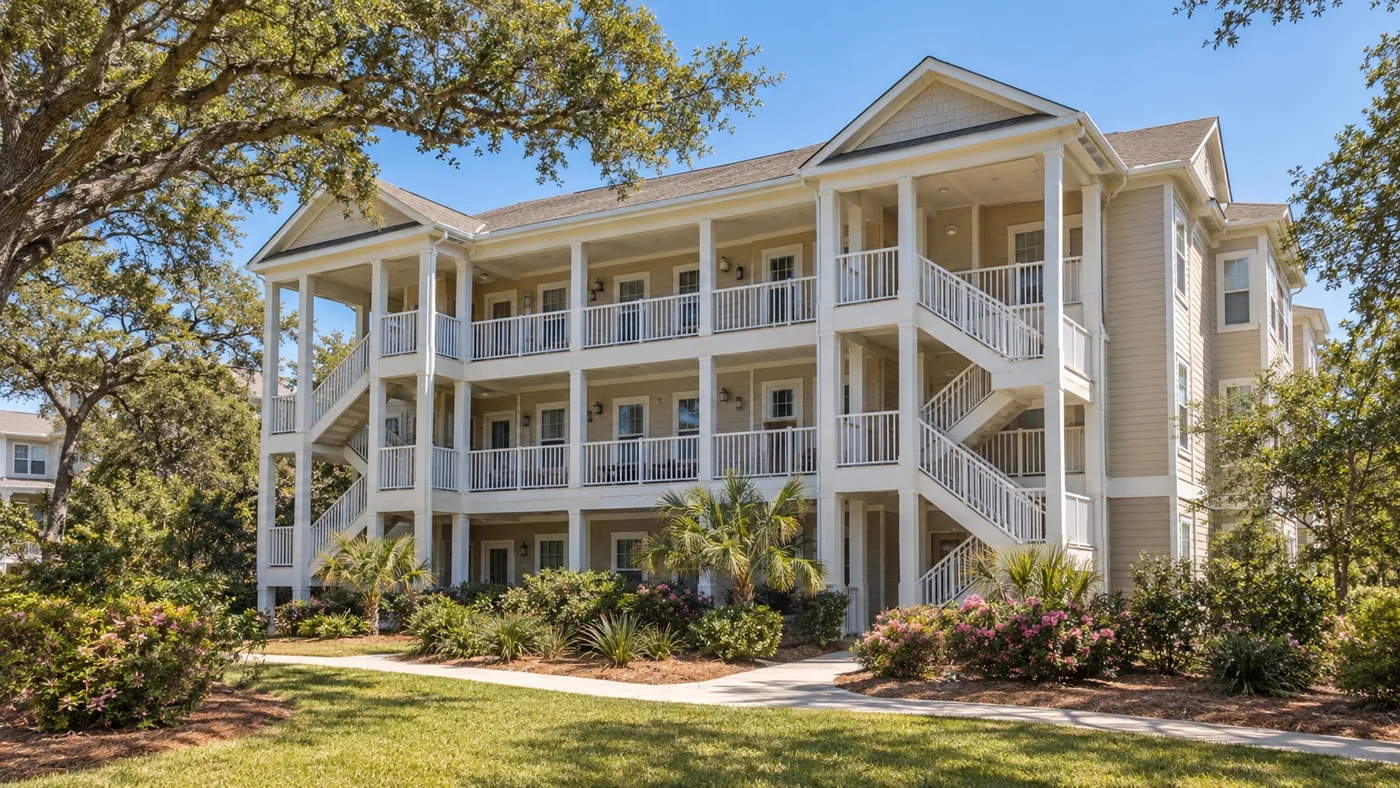
A North Carolina condo owner should coordinate a unit-owner policy with the association’s master insurance and governing documents. Review responsibility for interiors, improvements, belongings, liability, temporary housing and assessments. If coverage is difficult to obtain, suitable surplus options may be considered, but the master-policy gaps must still be understood.
Condo insurance works best when the unit owner and association are looking at the same documents. A phrase such as “the building is insured” does not establish who pays for kitchen improvements, a master-policy deductible, damaged personal belongings or the cost of living elsewhere.
You do not need to solve every issue alone. Start by gathering the association’s current insurance information and the documents describing responsibility for the property. An agent can then help identify the coverage your unit needs and explain where uncertainty remains.
Collect the master policy and governing documents first
Request the current master-policy declarations, relevant endorsements, deductibles and a description of the property insured. Obtain the condominium declaration and any amendments affecting insurance, maintenance or assessments. A short certificate is useful evidence, but it may not reveal exclusions or the full scope of property coverage.
Confirm that you are buying a legally created condominium rather than assuming every attached home has the same insurance structure. Townhomes can involve different ownership arrangements. The appearance of the building does not decide where your insurable responsibility begins or ends.
Give the documents to the agent quoting the unit policy. Identify any uncertainty about walls, fixtures, flooring, cabinets or improvements. Ask the association to clarify its position in writing and seek legal advice if documents conflict. Guessing at the boundary can leave a substantial gap even when both policies are active.
Understand the North Carolina framework without oversimplifying it
For condominiums to which it applies, North Carolina G.S. 47C-3-113 addresses association property and liability insurance, subject to availability provisions. Its treatment of units with horizontal boundaries includes an important distinction for owner-installed improvements and betterments. That is one reason a generic “walls-in” description is not enough.
The statute also recognizes that an owner may obtain insurance for the owner’s own benefit. The association’s policy therefore does not eliminate the need to evaluate individual belongings, liability, improvements and living expenses. Review the actual master contract rather than assuming the statutory framework guarantees payment for any particular loss.
Applicability, declaration language and the legal form of the community matter. This guide does not interpret a specific association’s obligations. If a dispute concerns which party must insure or repair a component, obtain advice based on the governing documents and applicable North Carolina law before choosing a coverage amount.
The Act’s applicability section distinguishes condominiums created after October 1, 1986 from older communities and extends only specified sections to earlier condominiums. Do not assume the insurance section applies identically to every North Carolina building; the creation date and governing documents need review.
Insure the interior property for which you are responsible
A unit-owner policy often provides building-property coverage for eligible interior items, alterations or improvements, but the amount must fit your responsibility. Inventory cabinets, flooring, built-in appliances, fixtures and renovations. Identify what was standard when the unit was built and what an owner later improved.
Do not use the unit’s purchase price as the interior coverage limit. That price can include land interests, common property, location and other factors. Ask for an estimate of the cost to replace the property your policy is intended to cover, including labor and associated repair work.
Review whether the form covers covered-loss repairs on a replacement-cost basis, what deductible applies and whether particular materials have limitations. If the master policy is changed at renewal, your unit-owner coverage may need adjustment even though nothing inside your home has changed. Keep the two reviews connected.
Protect belongings and temporary living expenses
Make a room-by-room inventory of furniture, clothing, electronics, household goods and valuables. Record photographs and reasonable evidence of value in a secure place outside the unit. Ask whether contents are covered at replacement cost or actual cash value and whether special limits apply to categories such as jewelry.
If a covered event makes the unit uninhabitable, loss-of-use coverage may address qualifying additional living expenses. Confirm the limit, duration, covered trigger and documentation requirements. It does not automatically reimburse every housing expense, and the association’s building repairs do not guarantee that your own temporary housing is covered.
Ask how the policy handles a situation where your unit has little damage but a shared building system prevents occupancy. The answer depends on the contract and circumstances. Keep records of normal living costs, added expenses and communications so a covered claim can be evaluated with useful documentation.
Read loss-assessment coverage and deductible limitations
An association may assess owners for costs after a loss. A unit-owner policy’s loss-assessment provision can address certain covered assessments, subject to its triggers, limits and exclusions. It is not a general fund for every special assessment or every budget shortfall.
Distinguish an assessment following covered damage from routine roof replacement, deferred maintenance, reserve funding or a known defect. Also ask how the policy treats an assessment for the association’s deductible. That situation may have its own restriction or sublimit, even when the overall loss-assessment limit appears substantial.
Obtain the master-policy deductibles and ask the association how they may be allocated. A hypothetical example: the master wind deductible is large, and the board allocates a portion to each affected owner. Your personal policy’s response depends on its assessment wording and exclusions, not simply on the amount printed beside “loss assessment.”
Check personal liability and water-damage concerns
The association’s liability policy and your personal liability insurance address different interests. Ask how your unit-owner policy applies if you are alleged to have caused injury or damage, including water escaping into another unit. The fact that another owner demands reimbursement does not by itself establish legal responsibility or coverage.
Review exclusions for business activity, rental use, certain animals or other relevant exposures. Tell the insurer if the unit is owned by a trust or entity, used by family members who live elsewhere, or rented. The insured parties and accepted use should match the actual arrangement.
If you carry an umbrella, confirm that the condo and underlying liability coverage qualify. Keep maintenance records for plumbing and appliances, and report leaks promptly through appropriate channels. Insurance should be reviewed alongside responsible upkeep; neither maintenance nor a policy makes every neighboring-unit dispute simple.
Still looking for a workable option?
An older roof, a nonrenewal, or a difficult property does not tell the whole story. Share the details so your available options can be evaluated.
Standard-market options are reviewed first. A request is an inquiry, not an offer or confirmation of insurance. Coverage is subject to underwriting.Coordinate coastal wind and flood at both levels
A coastal condominium can have separate property, wind and flood arrangements at the association level as well as individual owner coverage. Ask which building policy covers wind, what percentage deductible applies, and whether your interior property and belongings have compatible protection. Do not stop after confirming the association has a policy.
Flood is a separate question. NC DOI explains that ordinary homeowners coverage does not cover flood damage. Review the association’s flood coverage and your individual needs with an agent familiar with condominium flood arrangements. Building, contents, below-elevated-floor property and assessments can be treated differently.
Do not assume flood-related temporary housing or every assessment is covered. Ask for the relevant policy language and how separate policies interact. Similarly, an individual wind exclusion does not disappear because the master policy covers some building damage. The goal is to understand the layers before a storm requires several claims at once.
Disclose seasonal stays and rental activity
Explain whether the unit is your primary home, a seasonal residence, a long-term rental or a short-term vacation rental. Include any combination of those uses. An association’s permission to rent does not establish that an individual policy accepts rental activity.
If you provide furnishings, ask about their protection and guest-related damage. For income-producing units, review lost rental income separately from additional living expenses intended for an owner occupant. Ask how gaps between tenants or bookings affect the policy’s occupancy conditions.
Obtain association rules and management agreements where relevant, but avoid assuming a manager’s policy replaces yours. Review the short-term rental guide if paying guests stay briefly. A correct use description helps an agent look for a suitable form before a claim reveals that the policy contemplated something else.
Prepare a complete submission when coverage is difficult
A unit can become harder to insure because of its location, building condition, losses, ownership structure or use. Provide the current policy, nonrenewal notice, loss information and completed repair records. Include accurate details about the association’s insurance and any known building projects or unresolved damage.
Do not conceal an assessment or an inspection concern to obtain a quote. Explain the issue, what work is planned and who is responsible. An insurer may need more information, offer restricted terms, or decline. Accurate information helps prevent an offer based on facts that later prove incorrect.
If a surplus policy is considered, review the insurer, forms, exclusions and total cost. Surplus status does not tell you whether the condo-specific gaps are solved. Ask the agent to explain the reason for the proposed placement and compare relevant alternatives using the same master-policy information.
Use a coordinated condo coverage checklist
| Coverage question | Document to review |
|---|---|
| Who insures interior components? | Declaration, master policy and unit-owner building coverage. |
| How are assessments treated? | Association rules and individual loss-assessment wording. |
| What happens after wind damage? | Master wind terms, deductible and individual exclusions. |
| What protects belongings? | Contents limit, valuation and special sublimits. |
| Where will you stay? | Loss-of-use trigger, limit and duration. |
Ask the agent to mark unresolved items rather than filling them with assumptions. Request the proposed endorsements before accepting a material limitation. Review the complete price, including taxes, fees and payment terms, and check whether the lender has requirements for the unit policy.
A lower premium can be useful, but compare the risk retained by you as well. An inexpensive policy with an unsuitable interior limit or assessment restriction may not address the concern that led you to shop.
Keep association and individual renewals connected
Obtain updated master-policy information each year and after significant changes. Review interior improvements, valuables, occupancy and liability at the same time. Store current contact details for the association, manager and your insurer where they remain available if you must leave the building.
After damage, report promptly to the relevant parties, take photographs when safe, and keep receipts for reasonable protective measures. Ask which adjuster is handling each part of the loss and preserve written explanations of coverage decisions. Avoid assuming that another owner or the association has reported your individual loss for you.
If responsibility is disputed, separate the coverage question from the legal allocation question. An agent can help explain a policy, while a qualified attorney may be needed to interpret contested documents or obligations. The claims and complaints guide explains additional steps for organizing an insurance concern.
Frequently asked questions
Does the condo association insure everything inside my unit?
Not necessarily. Review the master policy, governing documents and applicable law. Improvements, belongings, liability and living expenses may require individual protection. A phrase such as walls-in is not a substitute for identifying the actual insured property and exclusions.
Will my policy pay every special assessment?
No. Loss-assessment coverage has specific triggers, limits and exclusions. Ordinary maintenance, reserves and other assessments may fall outside it. Master-policy deductible assessments can also have special restrictions, so ask about that wording separately.
Is a townhouse always insured like a condo?
No. The legal ownership and association documents matter, not just the building’s shape or marketing label. Confirm whether it is a condominium and which property you own or must insure before choosing the form and building limit.
Do I need individual flood coverage if the association has flood insurance?
Have both arrangements reviewed. Association building coverage may not address all of your belongings or other individual needs. Limits, valuation and exclusions differ, and flood-related assessments or living expenses should not be assumed covered.
Can I use the same policy when I rent out the unit?
Only if the insurer accepts the disclosed rental arrangement. Long-term tenants, short stays and seasonal personal use create different questions. Obtain confirmation before the use changes and review rental income and liability as well as property protection.
What should I request from the association before shopping?
Ask for current master-policy information, relevant endorsements, deductibles, the declaration and insurance-related amendments. Include known assessments, planned work and use restrictions. These documents help the agent identify your responsibilities instead of quoting from a generic condo assumption.
A clearer next step for your home.
Bring your coverage questions, property details, and deadline. Start a conversation about the options that may fit your situation.
Standard-market options are reviewed first. A request is an inquiry, not an offer or confirmation of insurance. Coverage is subject to underwriting.Sources and further reading
Official resources consulted for this guide. Program eligibility and policy wording can change; confirm the current requirements for your property.
- North Carolina G.S. 47C-3-113: Insurance
- NC DOI: Basic Homeowners Insurance
- NC DOI: Flood Insurance
- North Carolina G.S. 47C-1-102: Applicability
Last source check: 2026-10-30. This guide is general information, not a coverage determination. Read our editorial standards.